CSERC wraps up a successful year of volunteer projects on the Stanislaus National Forest
Logo
Since 1990
Banner
CSERC Blog
CSERC'S Eductional Programs espanol Spanish verion of site donate to CSERC

CSERC wraps up another successful year of volunteer restoration projects!


Bookmark and Share   

     2010 was another eventful and diverse year for restoration projects made successful by CSERC volunteers!  Partnering with the Forest Service for a diversity of efforts this summer and fall, here is a look back at all of the projects made a success thanks to our dedicated volunteers.


Tuolumne River trash cleanup

     CSERC staff and volunteers joined forces with the Forest Service and Nathan Ashmead, a high school senior who designated popular illegal dumpsites along the North Fork Tuolumne River as an area to cleanup for his senior project.   A huge amount of trash was cleaned up at multiple sites, making the day very productive and worthwhile.


Bull-Thistle removal in the Carson-Iceberg Wilderness-
            Many staff members have participated for multiple years in the effort to remove an invasion of the noxious plant species, Bull Thistle, which has infested a huge naturally occurring land slide area within the Wilderness.  Coordinating with the Stanislaus Forest botany department, CSERC staff and volunteers hiked tools out 3 miles to previously identified Bull Thistle plant locations.  Staff observed the number of bull thistle plants were significantly down from the numbers they had observed in the past, signaling the repeated efforts to stop this weed from spreading and taking over native plant habitat are finding success.

Electric fencing project at Bumblebee Meadow
            Staff and volunteers met with wildlife biologist for the Stanislaus, Adam Rich, in early July to help erect an electric fence around an existing aspen stand within Bumblebee meadow.  The fence was erected in order to prevent the younger aspen in the grove from being trampled and grazed on by livestock.  An interesting fact about aspen is that groves are usually a single plant organism, where the trees are shoots sprouting up from a shared root system.  Throughout North America there is an epidemic of aspen dying off, which presently all the reasons for are not currently understood.  In the western states, it is thought that fire suppression and grazing play roles in the die-off of aspen, and widespread efforts are being made to protect aspen and their habitat to stop the trend, as they are considered an important “keystone species” for the ecosystems in which they occur.

Fen fencing at Sapps Meadow
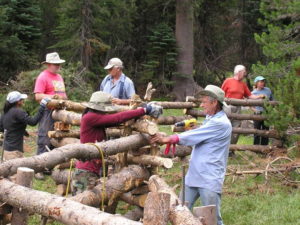
     One of the largest restoration projects our Center has ever helped to coordinate, the Sapps Meadow fencing project had a successful second year of volunteer project workdays.  Working closely with the Calaveras Ranger District, CSERC staff played a leading role on organizing and putting together a fencing project to prevent cattle from damaging one of the largest fens with special status plant species that occurs on our Stanislaus Forest.


     Fens are saturated meadow areas that have conditions that allow peat to form, a unique soil type that certain plants have specially evolved to be able to grow on.  The rare sundew plant found at this fen is a carnivorous plant that traps small insects on its sticky tentacles and digests them for needed nutrients that can’t be accessed form the peat soil.  The Sapps Meadow fen has been grazed and trampled upon by cattle for many years, damaging the fen habitat needed to create the proper growing environment for the sundew and other plants.  With the construction of the log fence around the fen at Sapps, CSERC is helping to ensure that this special place is protected from future livestock damage.


Fiddler’s Green Meadow restoration     
     The area known as the Leland Gully at Fiddler’s Green Meadow has long been an eyesore for visitors along the Herring Creek Road in the Stanislaus National Forest, and a classic example of a badly damaged meadow system.   After years of the Forest Service planning how to best restore this site, they received grant money for restoration through the National Fish and Wildlife Federation to help improve the area’s water-retaining capabilities (an intact meadow is like a sponge for the melting snowpack and has a significant groundwater supply) and wildlife habitat values. 

    
     Coordinating with the site restoration planner Tracy Weddle, hydrologist for the Stanislaus Forest, CSERC staff and volunteers were fundamental in re-vegetating the meadow with native plants.  Staff and volunteers gathered thousands of native flower and grass seeds to be distributed at the restoration site from nearby Bell Meadow.  Staff helped to distribute the seeds when the site was ready, and joined with two Forest Service staff members to cut hundreds of willow stakes from willow bushes at Saint Mary’s meadow to be propagated at the restoration site. 

     
      On November 6th, 30 volunteers from CSERC and the Summerville High Ecology Club showed up to plant the willow stakes in a productive and enjoyable day of restoration.  By replanting native plants and shrubs at the site, it is hoped that the recovery of the meadow will be improved, helping: return the site to its natural habitat values more quickly, preventing an invasion of non-native plants from colonizing the area first, and providing soil stability through root growth that helps to slow down soil erosion from water runoff.

Back to the top

BACK TO MAIN VOLUNTEER PAGE

RETURN TO CSERC HOMEPAGE


CSERC | PO Box 396 | Twain Harte, CA 95383 | (209) 586-7440 | info@cserc.org